Preventing Systemic Food Waste
Second Helpings rescue operations work to gather food from schools, restaurants, hotels, and grocery stores that were meant to end up in a landfill and repurpose it to ensure that it ends up in the hands of the communities that need it the most. Within the last year, Second Helpings has hit a record number of 5,005,212 lbs. rescued food that would otherwise be thrown away. Being able to turn this rescued food into nutritious meals is not the only positive outcome of our mission. Using food that would have otherwise gone to waste, we also prevented an estimated 2,503 tons of CO2 from being released into the atmosphere. This environmental impact is another important way our work supports a more sustainable community and demonstrates our commitment to protecting the environment.
Within about 18 million households in the United States food insecurity is a constantly growing issue. For just Indiana, about 1 in 7 people are burdened with not knowing where or how they are going to get a nutrient full meal (Source: Indiana University Health ). According to the United States Department of Agriculture, also known as the USDA , food insecurity can stem from a multitude of factors such as little access to affording food, having no form of transportation to get food, having enough consistency in their life without interruption, or not having been educated on how to live a nourishing lifestyle.
Second Helpings is making a difference with our daily efforts to rescue and redirect food. Through a system crafted by the Second Helpings Staff we can work with …number of companies… to have 6 redirect sessions a week. These sessions consist of any establishment that we work with such as churches, food pantries, food banks, etc… coming to our warehouse and "shopping" for free. Our team lays out the pallet's full food each week that Second Helpings has rescued and chosen to redirect to the other hands of the community. With these redirect sessions it ensures that Second Helpings has what we need to prevent food waste while also making sure that the food we do not use does not end up in the landfill.
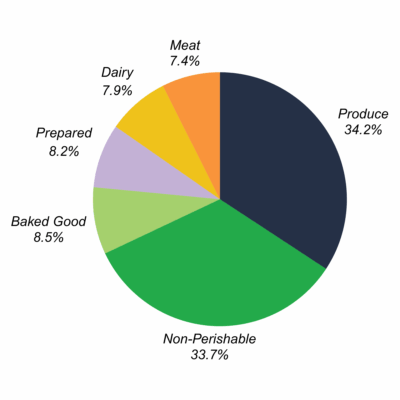
When it comes to our emissions, calculations consider all the food categories that Second Helpings works the closest with such as meat, produce, non-perishables, baked goods, prepared foods, and dairy products. This allows for the most accurate estimations on our emissions output since each category varies in its environmental impact.